

Toyota Financing & Leasing Guide for Bensalem & Langhorne Drivers
Author: Team Toyota of Langhorne
Navigating the congestion on Street Road during rush hour or merging onto the Pennsylvania Turnpike near Bensalem requires a vehicle you can trust implicitly. Securing that vehicle involves a financial decision that is just as critical as choosing between a RAV4 and a Camry. Whether you are commuting daily into Philadelphia from Levittown or running errands around Yardley, the method you choose to acquire your next Toyota will impact your monthly budget and long-term financial health. At Team Toyota of Langhorne, we understand that the jargon surrounding automotive finance can be as tricky to navigate as a pothole-filled winter road. We have spent years helping our neighbors in Langhorne, Bensalem, and the greater Philadelphia area clarify these choices. Our expertise allows us to break down the complexities of financing versus leasing, ensuring you have the knowledge to make a decision that fits your life in Bucks County. Learn more about our commitment to local drivers on our About Us page.
Key Takeaways (TL; DR)
- Building Equity vs. Flexible Terms: Financing is the traditional route to full ownership, allowing you to build equity with every payment. Leasing operates more like a long-term rental, typically offering lower monthly costs and the ability to upgrade to new models frequently.
- The Power of Credit Scores: Your credit history is the gatekeeper to interest rates. A robust credit score generally unlocks lower APR offers, significantly reducing the total cost of your vehicle over time.
- Toyota Financial Services Integration: As the captive lender for the brand, Toyota Financial Services (TFS) provides seamless integration with dealerships, offering exclusive rebates and loyalty programs not found at standard banks.
- End-of-Lease Freedom: When a lease concludes, you aren’t stuck. You can purchase the car for a set price, swap it for a 2026 model, or simply turn in the keys, providing unmatched adaptability to life changes.
- Incentives for Local Drivers: From military rebates for those serving near Willow Grove to programs for recent college grads from Philadelphia universities, Toyota offers targeted financial relief to eligible buyers.
- Bucks County Driving Factors: Your choice should reflect local realities. High-mileage commuters on I-95 might prefer buying, while those staying local in Bensalem might benefit more from leasing.
- Preparation is Profit: Arriving at the dealership with your documents organized—proof of income, insurance, and residency—can streamline the process and potentially help you lock in better terms.
What Does It Mean to Finance a Vehicle?
Is purchasing a car via a loan the right path for ownership?
For generations of drivers in Pennsylvania, financing has been the standard method of putting a new car in the driveway. This process is straightforward: you borrow the total cost of the vehicle (minus your down payment) from a lending institution. This lender could be a big bank, a local credit union in Levittown, or the manufacturer’s own finance arm, Toyota Financial Services. Over a set period—usually between 36 and 72 months—you repay the principal amount along with interest.
The core appeal of financing is the end game: ownership. Every check you write reduces the principal and builds your equity in the machine. Once the final payment clears, the lender removes their lien from the title, and the car is 100% yours. This route is particularly popular among drivers in Bensalem who view their vehicle as a long-term investment. If you plan to drive your Toyota until the odometer hits 200,000 miles, or if you want the freedom to modify the suspension for better handling on rough PA roads without asking for permission, financing is your best avenue. It offers a sense of permanence and stability that renting cannot match.
How Does Toyota Financial Services (TFS) Operate?

Why consider the manufacturer’s lender over a bank?
Toyota Financial Services (TFS) is not just another bank; it is a specialized financial institution dedicated solely to facilitating the sale and lease of Toyota vehicles. Because they are part of the corporate family, their goal isn’t just to collect interest, but to help you get behind the wheel of a Toyota. This creates a synergy that often benefits the consumer. TFS works hand-in-glove with dealerships like Team Toyota of Langhorne to create a friction-free transaction.
When you sit down to discuss a 2026 Toyota Tacoma or Prius, the application process for TFS is integrated directly into our dealership’s workflow. We submit your profile—looking at credit history, income stability, and debt obligations—directly to TFS. Because they understand the value of the vehicles better than a generic bank might, they can often offer more aggressive terms. Furthermore, TFS is the source of “subvented” rates—those special low APR offers you see advertised on TV. A general bank in Philadelphia typically cannot match a 1.9% or 2.9% APR promotion because those rates are subsidized by Toyota to encourage sales. You can research general auto loan trends at reputable sites like Edmunds.
What Is the Mechanics of a Lease Agreement?
Is leasing just renting a car for a few years?
Leasing is often misunderstood, but it is best described as paying for the portion of the vehicle’s life that you use. Unlike financing, where you pay for the entire value of the car, a lease payment is calculated based on depreciation. This is the difference between the car’s sticker price today and its estimated “residual value” (what it will be worth) at the end of the contract, typically two or three years down the road. You also pay a “money factor,” which is the leasing equivalent of an interest rate, plus taxes and fees.
Because you are only financing the depreciation rather than the full asset, monthly payments on a lease are almost always lower than loan payments for an identical vehicle. This financial structure makes leasing incredibly attractive for drivers in Yardley or Newtown who crave the latest technology. If having the newest safety suite for navigating I-295 or the most current infotainment system is a priority, leasing lets you upgrade constantly. It is a cycle of renewal that keeps you in a vehicle under factory warranty, shielding you from the repair costs that inevitably arise as vehicles age in our variable Northeast climate.
What Happens When the Lease Clock Runs Out?
What choices do you have when the contract ends?
One of the strongest arguments for leasing is the flexibility it provides at the end of the term. You are not tethered to the vehicle indefinitely. When your contract with Toyota Financial Services concludes, you face a fork in the road with three distinct paths, allowing you to adapt to whatever your life in Bucks County looks like at that moment.
- Purchase the Vehicle (Lease Buyout): Perhaps you fell in love with your RAV4. It handled the snow on Route 1 perfectly, and you’ve kept it in pristine condition. You have the contractual right to buy the vehicle for the residual value established when you signed the lease. If the used car market has spiked—something we’ve seen recently—and the car is worth more than the residual value, buying it is an incredibly smart financial move. You are essentially buying equity at a discount.
- Upgrade to a New Model: This is the most common choice. You bring the vehicle back to Team Toyota of Langhorne, hand over the keys, and slide into the driver’s seat of a brand-new 2026 model. This transition is seamless. You get a fresh car with zero miles, new tires, and that new car smell, often with loyalty incentives from Toyota that waive disposition fees or offer better terms.
- The Clean Break: Maybe you’re moving to a city with great public transit, or you just don’t need a second car anymore. You can return the leased vehicle, undergo a final inspection for excess wear and mileage, pay any disposition fees, and walk away. There is no hassle of listing the car on Craigslist or haggling with strangers over trade-in value.
Comparing the Two: Financing vs. Leasing

To make the right choice, you must look beyond the monthly payment and consider the structural differences of each path. Financing is a marathon; it requires stamina (higher payments) but ends with a trophy (ownership). Leasing is a series of sprints; it’s faster and lighter (lower payments), but you have to restart the race every few years.
For a driver in Bensalem who commutes to Center City Philadelphia every day, racking up 20,000 miles a year, leasing is likely a poor fit due to mileage penalties. Conversely, for a retiree in Langhorne who only drives to the grocery store and the golf course, leasing is brilliant.
Key Comparison Points:
Ownership Stakes:
- Financing: You own the asset. The title is yours once the debt is cleared.
- Leasing: The leasing company (lessor) retains the title. You are a long-term renter.
Monthly Budget Impact:
- Financing: Higher monthly outflow. You are paying for the whole car + interest.
- Leasing: Lower monthly outflow. You only pay for the depreciation + rent charge.
Initial Cash Outlay:
- Financing: A down payment of 10-20% is standard to avoid being “upside down” (owing more than the car is worth).
- Leasing: “Due at signing” costs can include the first month’s payment, taxes, registration, and acquisition fees. Cap cost reductions (down payments) are optional but lower the monthly rate.
The Freedom to Mod:
- Financing: It’s your car. Lift it, paint it, add aftermarket stereos—do whatever you please.
- Leasing: The car must remain stock. You must return it in factory condition, or face penalties.
Distance Limitations:
- Financing: Drive to California and back. There are no limits.
- Leasing: Strict caps (e.g., 10k, 12k, 15k miles per year). Exceeding these costs money (often 15-25 cents per mile).
Condition Requirements:
- Financing: Dents and scratches are annoying but don’t cost you money until you sell.
- Leasing: You are held to a standard of “normal wear and use.” Excessive scratches, stains, or tire wear will result in charges at turn-in.
Asset Value:
- Financing: You have an asset to trade in or sell later.
- Leasing: You walk away with no equity (unless you buy it out).
What Variables Determine Your Financial Terms?
How do banks decide what rate you deserve?
The offer you receive isn’t pulled from thin air; it is a calculated risk assessment based on specific data points in your financial profile. Understanding these variables can help you improve your standing before you even walk through the doors at Team Toyota of Langhorne.
The Credit Score Factor: This is the heavyweight champion of financial variables. Your FICO score tells lenders how reliable you have been with debt in the past. In the eyes of a lender, a score above 720 suggests a borrower who pays on time, every time, meriting the lowest interest rates (APRs). Scores below 650 might be seen as higher risk, leading to higher rates or requirements for larger down payments.
The Role of the Down Payment: Cash is king. The more money you put down upfront, the less risk the lender assumes. In a financing scenario, a substantial down payment reduces your loan-to-value (LTV) ratio, often qualifying you for better tiers of interest rates. In leasing, a down payment (capitalized cost reduction) directly reduces the monthly payment, though financial experts often advise against putting too much down on a lease since that money is lost if the car is totaled early in the term.
Duration of the Term: The calendar plays a role. Longer loans (72-84 months) lower your monthly obligation but drastically increase the total interest paid over the life of the loan. Shorter terms (36-48 months) spike the monthly payment but save you thousands in interest.
Debt-to-Income (DTI) Ratio: Lenders look at how much of your gross monthly income is already spoken for by rent, mortgages, and credit cards. If your DTI is too high, lenders may worry about your ability to handle a new car payment, regardless of your credit score.
Are There Exclusive Toyota Programs Available?
Can specific groups access hidden savings?
Toyota recognizes that reliable transportation is essential for certain groups transitioning through major life stages. To support these individuals, TFS offers targeted rebate programs. These are not just marketing gimmicks; they are real cash savings that can be applied to your down payment or cap cost reduction.
The College Graduate Rebate: For students graduating from local institutions like Temple University, Penn State Abington, or Bucks County Community College, transitioning to the workforce requires reliable wheels. Toyota offers a rebate for recent grads (and those graduating soon) to help them get into a new Corolla, Camry, or RAV4. This program acknowledges that while you may have a degree, you might not have a long credit history yet.
The Military Rebate: We have immense respect for those who serve. Eligible U.S. military personnel, including active duty, reserves, and retirees (within a certain window), can access a special rebate. This is our way of saying thank you to the service members living in and around our communities in Levittown and Bristol.
Loyalty Incentives: If you are already driving a Toyota, you are part of the family. Returning lessees are often eligible for “disposition fee waivers” or loyalty cash toward their next lease or purchase. It pays to stick with the brand known for durability.
Check the Toyota Financial Services homepage for the most current details on these national programs.
The Application Roadmap: Securing Your Toyota

What steps should you take to get approved?
The path to driving off the lot in Bensalem is paved with paperwork, but it doesn’t have to be bumpy. Modern technology has streamlined the approval process significantly. You can start the ball rolling from your sofa in Philadelphia before you ever drive up to our showroom.
Step 1: Digital Pre-Qualification: Visit our website or the TFS portal to fill out a pre-qualification form. This is a “soft pull” in many cases, meaning it won’t harm your credit score but will give you a ballpark idea of your buying power.
Step 2: Document Assembly: To finalize a deal, the bank needs proof that you are who you say you are. Gather your valid PA driver’s license, your most recent pay stubs (usually the last 30 days), and proof of residence (a PECO or water bill works well). You will also need proof of active auto insurance.
Step 3: The Formal Application: This is the detailed form where you list your employment history, income specifics, and housing costs. Submitting this triggers a “hard inquiry” on your credit report, which is necessary for the lender to extend a firm offer of credit.
Step 4: Contract Review: Once approved, our finance manager will present the “menu” of options. You’ll review the APR, the term, the monthly payment, and optional protections like GAP insurance or extended warranties. This is the time to ask questions. Never sign until you understand every line item.
The Cash Conundrum: Buy Outright or Finance?
Is paying cash always the smartest move?
There is a certain psychological freedom in paying cash. You drive away with the title in hand and zero monthly obligations. For disciplined savers in Langhorne, this feels like the ultimate win. However, financial advisors often present a counter-argument: opportunity cost.
If you drain your savings account of $35,000 to buy a car, that money is now illiquid, tied up in a depreciating asset. If you could instead finance that car at a promotional rate of 2.9%, while keeping your cash in a high-yield savings account or investment portfolio earning 5% or more, financing is actually the mathematically superior choice. You maintain your liquidity for emergencies—like a sudden home repair after a storm—while your money earns more interest than the loan costs you. The decision depends on your personal comfort with debt versus your desire for liquidity.
Understanding Pennsylvania Vehicle Sales Tax
How does the Commonwealth tax your purchase?
Taxes are an inevitability, and in Pennsylvania, vehicle transactions are subject to specific rules. The statewide sales tax rate is 6%. However, if you live in Philadelphia, there is an additional local tax that increases the rate to 8%. For residents of Bucks County (Bensalem, Langhorne, Levittown), the rate typically sits at the state level, but it’s crucial to verify current local rates.
The tax is calculated on the net purchase price. This is a critical distinction. If you buy a car for $30,000 and trade in your old car for $10,000, you are only taxed on the difference: $20,000. This trade-in tax credit is a massive advantage of trading in your vehicle at the dealership rather than selling it privately. Whether you finance or lease, taxes are collected. In a lease, taxes are often rolled into the monthly payment, whereas in a purchase, they are part of the total amount financed. These funds go toward maintaining the infrastructure we use daily, from the bridges over the Delaware River to the pavement on Lincoln Highway.
Weighing the Pros and Cons

A localized breakdown for Bensalem drivers
Making the final call requires balancing the scales. Here is how the pros and cons stack up for our local area.
Financing: The Long Game
- Pro: Total Control. No one can tell you that you can’t install heavy-duty floor mats or a roof rack for your trips to the Poconos.
- Pro: Unlimited Mileage. Commute to King of Prussia or take road trips to the Jersey Shore every weekend without watching the odometer.
- Pro: Asset Building. When you finish paying, you have a car worth thousands of dollars that acts as a trade-in for your next one.
- Con: Post-Warranty Risk. Once the warranty expires, a transmission failure or AC repair comes directly out of your pocket.
- Con: Depreciation Risk. If the model becomes unpopular or gas prices spike affecting resale value, you bear that loss.
Leasing: The Flexible Path
- Pro: Budget Friendly. Lower monthly costs mean you might afford a Highlander instead of a RAV4, giving you more space for family trips to Sesame Place.
- Pro: Tech Refresh. Every 3 years, you get the latest hybrid efficiency and safety tech, which is vital for navigating aggressive Philly traffic.
- Pro: Warranty Coverage. You are almost always covered by the factory warranty for the entire duration of the lease.
- Con: Mileage Anxiety. If your job moves further away, you might stress about hitting your 10,000 or 12,000-mile annual cap.
- Con: No Equity. You make payments for years but own nothing at the end. It is purely an expense, not an investment.
You can compare safety ratings and vehicle values on Kelley Blue Book (KBB) and Consumer Reports.
Strategic Tips for the Best Deal
How to negotiate like a pro in Bucks County.
Getting the best deal isn’t about luck; it’s about preparation. Here is how to position yourself for success at the finance desk.
- Know Your Credit: Pull your credit report from the major bureaus before you shop. If you see an error, dispute it. Walking in knowing you are a “Tier 1” borrower gives you confidence.
- Shop Rates: Don’t assume the dealer has the only option. Check with your local credit union or bank. If you have a pre-approval letter in hand, the dealership will work hard to beat that rate—often utilizing TFS’s buying power to do so.
- Timing Matters: Dealerships have monthly, quarterly, and annual targets. Shopping at the end of the month, or during major sales events like the “Toyotathon” near the end of the year, can yield significant savings.
- Focus on “Out the Door”: Don’t just negotiate the monthly payment, as terms can be extended to hide the true cost. Negotiate the “out the door” price of the vehicle first. Once that is settled, then discuss financing terms.
Frequently Asked Questions (FAQs)
What specific credit score allows for the best Toyota financing rates in Langhorne?
To qualify for the absolute best promotional APRs advertised by Toyota (such as 0% or 1.9%), customers generally need a credit score in the “Tier 1+” range, which is typically 720 and above. However, competitive rates are often available for scores in the high 600s, and Toyota Financial Services has programs for a wide variety of credit profiles found in the Bensalem area.
Does Team Toyota of Langhorne offer financing for first-time buyers with no credit?
Yes, Toyota has a specific “iFi” program designed for buyers with limited credit history but strong educational or employment backgrounds. If you have a qualifying degree and a job offer, you may be able to secure financing without a traditional co-signer, helping you build your credit file from scratch.
Can I lease a Toyota if I drive more than 15,000 miles a year commuting to Philadelphia?
While standard leases usually cap at 12,000 or 15,000 miles, you can purchase “extra miles” upfront at a discounted rate if you know you are a high-mileage driver. However, if you are driving 20,000+ miles annually, financing the vehicle is often the more mathematically sound decision to avoid heavy penalties at lease return.
Are there tax advantages to trading in my current car when buying a new Toyota in PA?
Absolutely. Pennsylvania law allows for a “trade-in tax credit.” This means you only pay sales tax on the difference between the price of the new car and the value of your trade-in. This can save you hundreds, or even thousands, of dollars in taxes compared to selling your old car privately and then buying a new one without a trade.
About Team Toyota of Langhorne
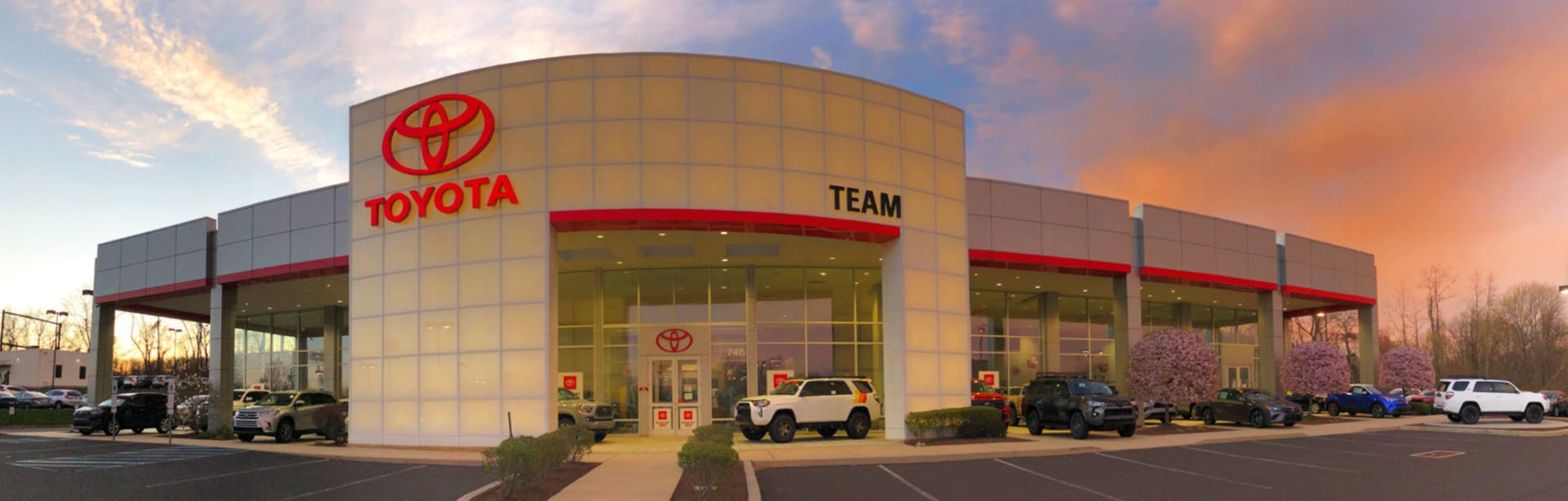
Team Toyota of Langhorne has been proudly serving the community since 1990, earning recognition as a Toyota President’s Award-winning dealership. As a family-owned business, we combine decades of expertise with a customer-first approach, offering no-haggle pricing, same-day financing, and exclusive programs like our VIP customer club and loyalty rewards. Our eco-friendly certified facility and over 80 service bays ensure top-notch care for your vehicle, with conveniences like complimentary loaner vehicles, express service lanes, and a quiet room for your comfort. We’re committed to making car ownership easy and enjoyable, with personalized video walkarounds, first-time buyer programs, and transparent “out-the-door” pricing. At Team Toyota of Langhorne, we’re more than a dealership—we’re a trusted partner in your automotive journey.
Related Articles:
Bensalem Driver’s Guide: Finding a Toyota Dealer You Can Trust